Questions to Ask a Car Seller Before You Drive Out
Nine questions that filter out bad listings over the phone. How to tell in ten minutes whether the trip is worth making, and what evasive answers actually mean.
Questions to Ask a Car Seller Before You Drive Out
Nine questions that filter out bad listings over the phone. How to tell in ten minutes whether the trip is worth making, and what evasive answers actually mean.
The most expensive part of buying a used car is not the price or the inspection. It is the viewings that should never have happened.
Three hours on the road to see a car that ten minutes on the phone would have ruled out. Here are nine questions that do the ruling out.
What matters is often not the answer but how the question lands. Each one below says what to listen for.
1. Are you the owner, or selling on behalf of someone?
The most informative question, and the first. A trader is not automatically worse than a private owner, but the conversation is different: they do not know the car's history, they know its condition at the point they bought it.
A vague "I am just helping someone out" means a trader who would rather not say so. That is not a reason to hang up. It is a reason not to believe stories about "one careful owner."
2. How long have you had it?
If the answer is two weeks, everything they tell you about the car's past is second-hand from the previous seller.
If it is five years, you can ask about history properly.
3. Why are you selling?
An ordinary question, but listen to the willingness to answer rather than the content. "Buying something bigger", "not using it", "moving" are all fine. A pause and a drifting answer is not.
4. What has been done to it in the last year?
This shows whether the car has been maintained at all. An owner who drives and looks after a car answers in detail: what was replaced, when, where.
"Nothing really, it has been fine" on a car with mileage means one of two things: it was not maintained, or they would rather not say.
5. What will need doing soon?
The most useful question on the list, and almost nobody asks it.
An honest seller names two or three items, because every used car has them. "Nothing, just get in and drive" on a car over five years old is not a good sign. It is a refusal to have the conversation.
6. Has it been in an accident? Has any panel been resprayed?
Ask both, they are not the same question. Paint gets redone without accidents.
Write down the exact wording. If a paint gauge later shows filler where the seller said "all original", the issue is no longer the paint. The issue is what else was said that was not true.
7. Can you give me the VIN?
A VIN is not confidential. Refusing to share it ends the conversation; there is nothing to continue.
Once you have it, order a history report before you travel. It shows what was recorded: registered accidents, mileage entries, theft and finance status.
8. Would you be happy for me to arrange an independent inspection?
Ask this on the phone, not at the car. It saves more time than any of the other eight.
A reasonable seller agrees: they have nothing to hide and an inspection speeds the sale up. Refusal, or "why, I have told you everything", is already an answer about the car's condition.
If the car is in another city, the inspection can happen without you travelling: an inspector goes to the car and sends you the report.
9. How many people have viewed it?
An indirect question that tells you a lot. If the car has been listed a month and ten people have seen it without buying, they are all seeing something you have not.
Two viewings in a week is a normal pace.
Three answers that end the trip
Some phrasings close the option on their own. Not because the seller is dishonest, but because they have just told you there will be no conversation.
"Come and have a look, you will see everything here." Said in answer to a specific question about condition, this means they do not want to answer. By the time you are standing there you have already spent three hours, and the pressure is on you.
"Take it now, I have another buyer coming." Urgency created by the seller always works against the buyer. A real second buyer does not need to be mentioned to you.
"No need to inspect it, I am telling you everything honestly." Someone with nothing to hide does not object to an inspection, because the inspection confirms what they said. Objecting means they know something they have not mentioned.
None of these proves dishonesty. Each one shows you would spend a day on a conversation where nobody intends to answer you.
What not to do on the phone
Do not negotiate. Before the viewing you have no grounds, and a figure named early will tie you to it later, when you do have grounds to ask for more.
Do not fire all nine questions in a row. It sounds like an interrogation and people close up. A conversation, not a form: three or four questions, listen, then a few more.
Do not trust photos. Light, angle and editing hide half of it. A photo is a reason to call, not a reason to drive.
What to do with the answers
After the call you have one of three outcomes.
Not worth the trip. Evasion on the VIN, refusal of an inspection, contradictions in the history. You just saved a day.
Worth it, but inspect first. Everything sounds reasonable and the car is interesting. Then the next step is not the drive, it is the inspection. What happens during a car inspection covers what that involves.
Go now. The car is nearby, the price is in line, the seller answers calmly. Even then, inspect against a list rather than by eye. The used car checklist covers what to look at.
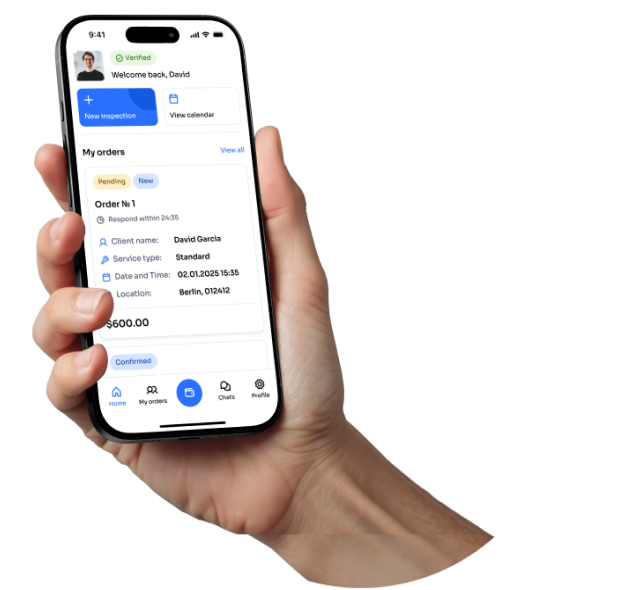
Book an independent inspection in the QOVO app: a verified inspector drives to the car, examines it with instruments and sends you a digital report with photos and measurements.

Buying or selling — know the truth first
The professional platform for vehicle inspectors. Set your schedule, take orders, deliver verified reports — and build a reputation that speaks for itself.